



Author: Nada Sharif
Critical thinking is often treated as an innate quality that individuals either possess or lack. However, this claim is increasingly difficult to sustain in light of educational and psychological research, which suggests that critical thinking is, in fact, a skill that can be cultivated and refined through deliberate and consistent effort. This process involves engaging in activities such as reasoning, reflection, and evaluation, which serve to strengthen one’s capacity for thoughtful analysis. Contrary to the idea that critical thinking appears spontaneously upon reaching a certain level of intellectual maturity, evidence points to a gradual development that occurs over time through structured, sustained practice.
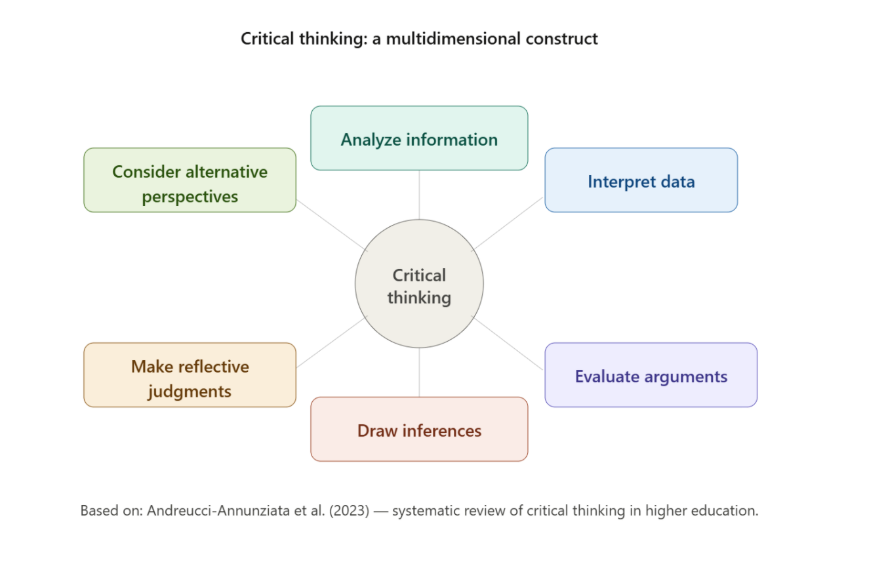
Recent reviews of the literature show that critical thinking is commonly understood as a multidimensional construct — including the ability to analyse information, interpret data accurately, evaluate arguments and evidence, draw logical inferences, and make reflective judgments.¹ These components rely heavily on active cognitive processes and pedagogical strategies that promote engagement rather than passive absorption of information.
In today’s landscape — characterized by an overwhelming influx of data, rapid communication, and a proliferation of unverified claims — the importance of developing robust critical thinking skills becomes even more apparent. The capacity to pause before reacting, to assess the credibility of sources, and to consider alternative perspectives is essential for navigating complex information environments responsibly.
Critical Thinking as Practice Rather Than Talent
Ina review on “Teaching Critical Thinking Skills” by Nada Alsaleh, a professor at the Instructional Technology Department, School of Education, King Saud University in Riyadh, Prof. Alsaleh suggests that critical thinking can be cultivated through explicit teaching approaches and structured opportunities for practice rather than left to develop indirectly. Her literature review noted that the development of critical thinking depends on intentional pedagogical methods and repeated cognitive engagement — not merely on exposure to subject content. In other words, individuals become better critical thinkers by practicing the work of critical thinking itself: questioning evidence,comparing interpretations, clarifying assumptions, and justifying conclusions.²
Educational psychologist Deanna Kuhn emphasizes viewing critical thinking as an ongoing, dynamic activity rather than a fixed trait. She advocates understanding it as a process that develops both socially and internally, through practices like anticipatory reasoning, predicting possible outcomes, and revising judgments in light of new evidence.³ This perspective shifts the focus away from questioning whether critical thinking can be improved, and toward exploring how it can be integrated into daily routines and learning experiences.
Accordingly, the question is not whether people are naturally “born” critical thinkers, but how environments and routines can support the gradual strengthening of critical thought.
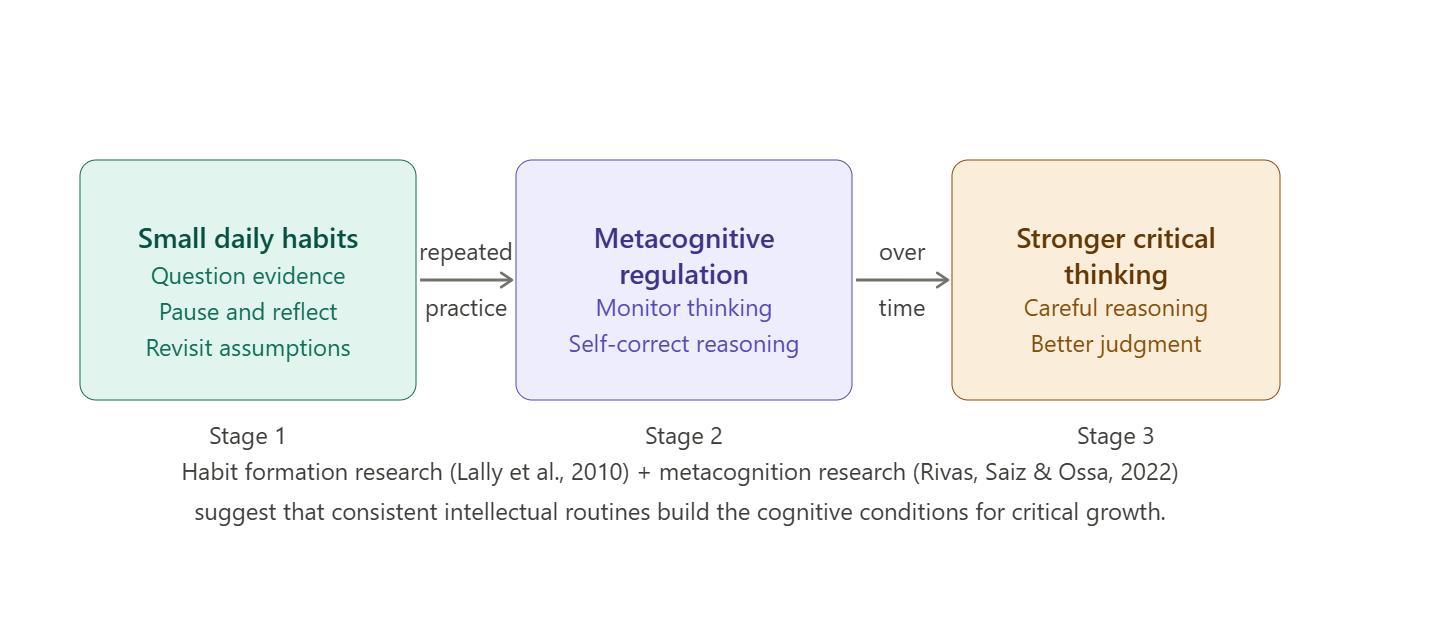
One productive answer lies in the logic of repeated practice. Research on habit formation suggests that small actions, when repeated consistently in stable contexts, can become more automatic over time. While habit research does not specifically claim that critical thinking itself becomes automatic in a simple or mechanical sense, it does provide a useful framework for understanding how small intellectual routines — such as checking evidence, revisit in gassumptions, or pausing before judgment — may become more regular features of a person’s thinking.⁴
Similarly, research on metacognitive strategies in higher education argues that critical thinking is best understood not as a fixed talent, but as a developable practice supported by repetition, reflection, and metacognitive regulation.⁵ By bringing together research on habit formation, metacognition, and critical thinking development, it becomes clear that small daily habits may help cultivate stronger judgment over time. The argument is not that isolated routines automatically produce sophisticated reasoning, but that repeated practices can create the cognitive conditions under which critical thinking is more likely to grow.
This framing is particularly useful for everyday life, because it suggests that modest but repeated intellectual habits may contribute to more careful judgmentover time. Critical thinking, in this sense, is better seen as something one does and develops than something one simply has.
Daily Habits That Support Critical Thinking
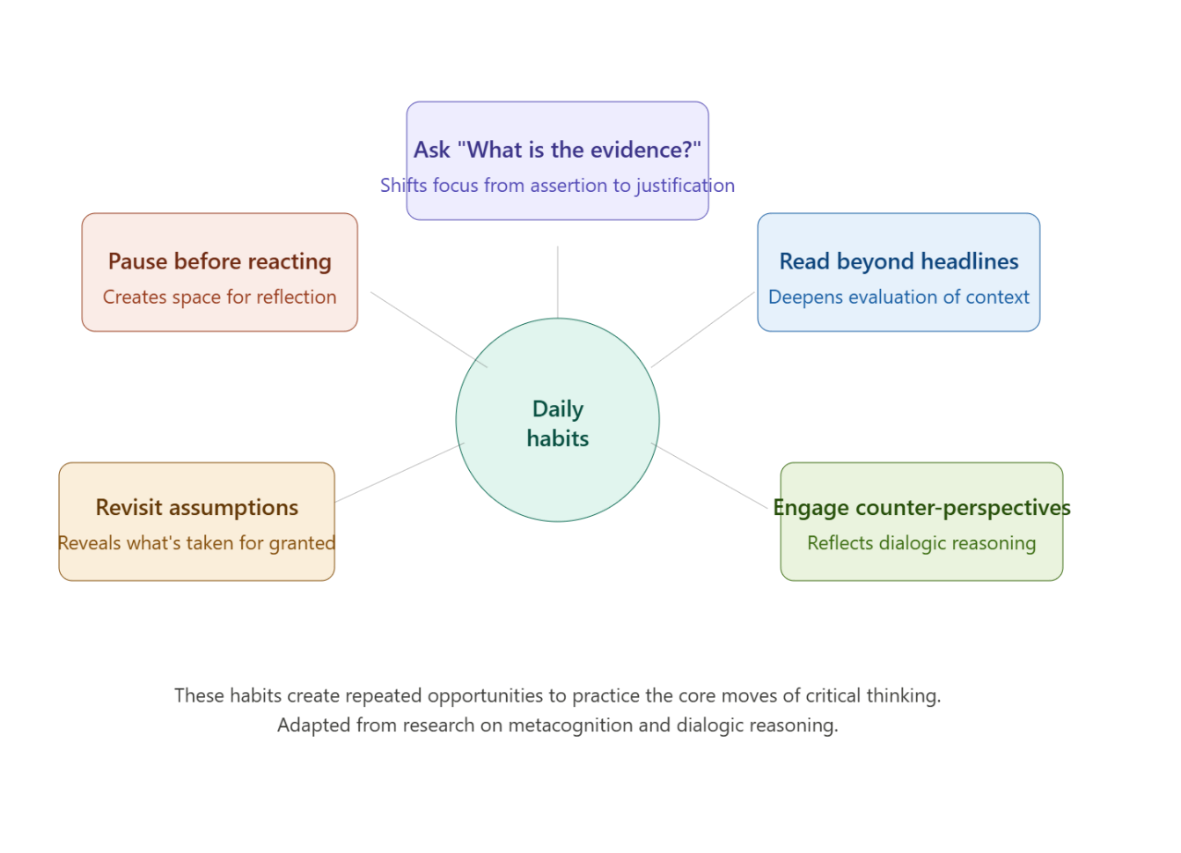
While critical thinking cannot be reduced to a checklist of behaviours, the literature does suggest that certain repeated practices can help cultivate the cognitive habits associated with stronger judgment. Daily routines that prompt individuals to examine evidence, monitor their own thinking, and engage with alternative viewpoints align closely with research on metacognition and dialogic reasoning. Metacognition — the directing, monitoring, and regulation of one’s own cognitive processes — has been shown to predict critical thinking ability even beyond working memory capacity.
From this perspective, five habits in particular stand out as practical expressions of reflective and analytical thinking:
• Asking “What is the evidence?” — disciplines judgment by shifting attention from assertion to justification.
• Pausing before reacting — creates space for reflection rather than impulsive response.
• Revisiting assumptions — helps reveal what has been taken for granted.
• Reading beyond headlines — encourages deeper evaluation of context, framing, and source credibility.
• Engaging with counter-perspectives — reflects the dialogic character of critical thinking described by Kuhn: weighing claims,objections, and rebuttals
These habits should not be understood as a guaranteed formula for intellectual growth. Rather, their value lies in creating repeated opportunities to practise the core moves of critical thinking in everyday life. This interpretation is consistent with research showing that critical thinking is strengthened through structured and repeated engagement — including problem-based learning environments that require learners to analyse information, compare alternatives, and justify decisions. Over time, such small but consistent practices may help make careful reasoning a more regular feature of how individuals interpret information and reach conclusions.
This understanding is also reflected in the methodology of Thinking Oasis, where critical thinking is approached as a practice cultivated through questioning, reflection, dialogue, and consistent engagement with ideas and real-world problems.
Conclusion
Critical thinking is not best understood as a fixed talent, but as a practice that can be strengthened over time. Research on habit formation, metacognition, and critical thinking development consistently points to the same conclusion: small, repeated habits — such as questioning evidence, revisiting assumptions,and engaging with alternative perspectives — can support better judgment. While no single routine guarantees intellectual growth, the cumulative effect of consistent daily practice can help make reflective and reasoned thinking a moreregular part of everyday life.
For those seeking to develop sharper judgment, the invitation is not to find a break through insight, but to begin small, stay consistent, and trust the process. Critical thinking, like any skill, is built one thoughtful habit at a time.
Interested in our methodology?
Get in touch with us to start your journey with Thinking Oasis using our custom designed Programs.
know more through our social media platforms:
References
[1] Andreucci-Annunziata P,Riedemann A, Cortés S, Mellado A, del Río MT and Vega-Muñoz A (2023).Conceptualizations and instructional strategies on critical thinking in highereducation: A systematic review of systematic reviews.
[2] Alsaleh, N. (2020). TeachingCritical Thinking Skills: Literature Review. TOJET: The Turkish Online Journalof Educational Technology, 19(1). Retrieved fromhttps://files.eric.ed.gov/fulltext/EJ1239945.pdf
[3] Kuhn, D. (2019). CriticalThinking as Discourse. Human Development, 62(3), 146–164.
[4] Lally, P., van Jaarsveld,C.H.M., Potts, H.W.W. and Wardle, J. (2010). How are habits formed: Modellinghabit formation in the real world. European Journal of Social Psychology, 40,998–1009.
[5] Rivas SF, Saiz C and Ossa C(2022). Metacognitive Strategies and Development of Critical Thinking in HigherEducation. Frontiers in Psychology.


